New issue of APF out

I’ve just received my copy of Archiv für Papyrusforschung 62/1 (2016):apf
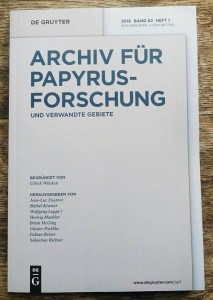
I have in it an edition of a papyrus fragment of the Shepherd of Hermas housed in Paris (of the same leaf as the Hermas papyrus fragment in Prague) which I’ll upload soon here. I imagine the whole issue will be uploaded (for those with some sort of subscription, I believe) on the webpage of the journal, here. It is not live just yet.

I would also mention Christian Vassalo, “A Catalogue of the Evidence for Presocratics in the Herculaneum Papyri” the title is self-explanatory.  NT people may  well be interested in Peter Malik’s article on P.Beatty III (P47 in NT textual criticism, contains good parts of the Apocalypse of John, LDAB 2778) which pleads for an approach to early Christian codices that integrates the study of non- or paratextual and textual features, and discusses scribal corrections and the link between re-inking and textual variation.

Funded PhD at KU Leuven, Updated

There is an opportunity in Leuven for a PhD in Theology and Religious Studies. The way this works is the following: if you get this position, you have one year of funding  (starting in September, about 1800 euro/month net) in which one works and further refine one’s project with a supervisor (named ‘promoter’ here), and applies in January/February for a full PhD fellowship to the Belgian research agency – the FWO – for further four years (this one). UPDATE: There is an additional opportunity for after the first year, apart from the candidate’s FWO application: the promoter can also submit a project application with the FWO or the Research Council of KU Leuven. Two shots at it, as it were.

This means that if you get that, you end up with five years of full funding which should be enough to complete a thesis, take a few steps toward its publication, and apply for postdocs.

If you happen to be interested, I suggest you check the details, here (updated link), and get in touch with a professor in the faculty right away. The deadline is August 18 (updated).

There are here professors of Greek, respectively Latin Patristics, and the two professors of New Testament are interested in reception history as well.

Good luck!

Fresh on Augustine on the Hebrew Bible in the JTS

Edmon Gallagher posted on academia.edu the prepub version of a forthcoming JTS article: “Augustine on the Hebrew Bible“. Enjoy!

Abstract:

Augustine’s support for the Septuagint as the true Christian Old Testament never waned, but his understanding of the relationship between the Hebrew Bible and the Septuagint did develop over his career. His earliest statements assume that the Seventy translators faithfully rendered the Hebrew text, with any discrepancy resulting from ambiguity in the source text. His correspondence with Jerome convinced him that there was more to it than that. Augustine’s mature writings evidence an innovative theory whereby both the Hebrew text and its Greek translation could be correct, guiding the reader to spiritual insight, even if they said different things.

Fresh on Eriugena’s Biblical Interpretations

New book on Eriugena’s biblical exegesis:

Andrea Cavallini, La penna del pavone: Bibbia ed esegesi in Giovanni Scoto Eriugena (Fundamentis Novis 5; Rome: Cita nuova, 2016).

This seems to a revised version of Cavallini’s PhD thesis. The author has uploaded the introduction, conclusions and the TOC on his academia.edu page, here.

Blurb:

L’ermeneutica biblica di Giovanni Scoto, il contesto culturale, la dottrina e la pratica Giovanni Scoto, detto l’Eriugena (sec. IX), è senza dubbio uno dei pensatori più profondi e audaci dell’Alto Medioevo, capace di unire fides e ratio, tradizione latina e tradizione greca, Bibbia e arti liberali, in un’unica e armonica costruzione filosofico-teologica. In essa l’interpretazione della Scrittura gioca un ruolo centrale e costituisce il più difficile e importante campo d’azione della ragione umana. I significati del testo biblico sono infiniti, come innumerevoli sono le sfumature di colore che si ammirano in una sola penna di pavone, perché infinita è la ricchezza di Colui che nella Scrittura si rivela nascondendosi. Il volume introduce il lettore all’ermeneutica biblica di Giovanni Scoto, presentandone il contesto culturale, la dottrina e la pratica.

Latin Patristic Hermeneutics

New volume from CUP, announced for April:

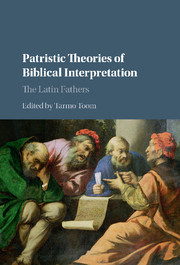
Tarmo Toom (ed.), Patristic Theories of Biblical Interpretation: The Latin Fathers (Cambridge: CUP, 2016).

latin

Blurb:

This volume provides an in-depth analysis of patristic hermeneutics for those who research, teach, or study the early church and the interpretation of Scripture. It focuses exclusively on Latin authors – such as Jerome, Augustine, and Gregory – whose writings contain substantial discussion of hermeneutics and who were known, read, and cited in the Middle Ages and beyond. In this collection of essays, leading international experts in the field identify key passages on patristic hermeneutical theory and demonstrate how the works of these authors have been fundamental for Latin traditions of biblical interpretation. Patristic Theories of Biblical Interpretation offers a selective yet comprehensive guide to a previously understudied area.

Contents:

1. Introduction | Tarmo Toom
2. Tyconius’ hermeneutics: the way the Holy Spirit expresses itself though the Scripture | Jean-Marc Vercruysse
3. Jerome’s hermeneutics: how to exegete the Bible? | Aline Canellis
4. Augustine’s hermeneutics: the science of the divinely given signs | Tarmo Toom
5. Cassian’s hermeneutics: purity of heart and the vision of God | Christopher J. Kelly
6. Junillus Africanus’ hermeneutics: Antioch and beyond | Peter W. Martens and Alden Bass
7. Cassiodorus’ hermeneutics: the Psalms and the arts of language | Rita Copeland
8. Gregory’s hermeneutics: scripture as a path to God | Brendan Lupton
9. Isidore’s hermeneutics: the codification of the tradition | Thomas O’Loughlin.

Two CfPs in Patristics

The first just arrived in an AIEP/IEPS email. It is in St Petersburg, 9-11 September 2016.

The Asia-Pacific Early Christian Studies Society invites proposals for papers to be delivered at its tenth annual conference to be held at State University of Aerospace Instrumentation (SUAI), St Petersburg, Russia, from Friday morning, 9 September to Sunday afternoon, 11 September, 2016, convened by Basil Lourié. Papers are 30 minutes in duration (20 minutes delivery and 10 minutes for discussion). The Society welcomes all proposals that explore any theme relevant to the early Christian world from the New Testament to the end of Late Antiquity, and especially those that focus on this year’s theme: Survival of Early Christian Traditions. A 100-word abstract should be sent by 30 April, 2016 to Dr. Geoffrey D. Dunn (geoffrey.dunn@acu.edu.au). Registration forms and further details will be available soon on the Society’s website at http://www.cecs.acu.edu.au/apecss.htm [this link does not work yet]. For more information, see the attached file, here.

The other one is further away still, but should include some papers on patristic exegesis.

The Seventh Saint Andrew’s Patristic Symposium, 23-24 September 2016, focuses on the personality, contributions and legacy of Saint John Chrysostom. Keynote speakers: Prof. Pauline Allen and Dr. Wendy Mayer. Plenty more information is available here.

There you have it.

The latest on the latest Origen homiletic trove

Lorenzo Perrone has uploaded on academia.edu a forthcoming piece of his on Origen’s ‘new’ homilies on Psalms found in Codex Monacensis Gr. 314 (published last year, see here), specifically on the exegesis of Psalm 76: “Scrittura e cosmo nelle nuove omelie di Origene sui Salmi: l’interpretazione del Salmo 76,” Acta Antiqua, forthcoming.

On the same platform, L. Perrone has usefully uploaded a dossier of his publications on these homilies, here.

Béatrice Bakhouche on the history of intepretation of Genesis 1:1-8

New book from Brepols:

dIS-9782503567037-1

B. Bakhouche
Science et exégèseLes interprétations antiques et médiévales du récit biblique de la création des éléments (Genèse 1,1-8)

Series: Bibliothèque de l’Ecole des Hautes Etudes, Sciences Religieuses (BEHE 167).

Blurb:

Les huit premiers versets de la Genèse parlent de la création : commencement du monde, principe divin du monde, affirmation d’une toute-puissance en action. Mais du texte hébreu à ses versions grecques et latines, ce texte fondateur pose de nombreuses difficultés de vocabulaire et d’interprétation, difficultés auxquelles se sont confrontés les exégètes du monde antique et médiéval. Que ce soit dans la littérature exégétique, encyclopédique, poétique, voire dans les représentations figurées, l’articulation de l’exégèse n’est pas univoque, mais dépend des langages adoptés, littéraires ou artistiques, tout autant que des objectifs poursuivis. On assiste à la mise en œuvre d’une culture diversifiée, mais cette diversification recoupe souvent une non-diversification dans l’interprétation qui est au moins tendanciellement d’ordre spirituel. Réciproquement, dans le déchiffrement du monde, les différents savoirs constituent autant de degrés qui mènent à Dieu.

Il est d’autres questions, d’ordre plus spécifiquement « littéraire » : comment les exégètes antiques ou médiévaux ont-ils abordé ce récit de la Création ? Quelle(s) logique(s) du texte sacré ont-ils dégagée(s) au fil du temps ? Comment problèmes et réponses évoluent-ils à travers les commentaires en hébreu, grec ou latin ? À l’étude du substrat scientifico-philosophique doit donc s’ajouter celle de la mise en forme du texte.

Announced for 04/2016.

CfP: The Sixth British Patristics Conference

Held in Birmingham, in September 5-7, this conference has an emphasis on patristic biblical exegesis: “we are particularly keen to receive contributions on the reception of Pauline literature or commentaries more generally”. More details here. Birmingham is also the place for the COMPAUL project on the earliest Pauline commentaries.

Another CfP which might allow some papers on Patristics would be that of the St Andrews Symposium for Biblical and Early Christian Studies: “Son of God: Divine Sonship in Jewish and Christian Antiquity”. Details here.

Blog at WordPress.com.

Up ↑