A Pre-Nicene Context for Origen’s Christology

The latest issue of  Ephemerides Theologicae Lovanienses  – 92/3 (2016) – includes the following article: “Origen’s Christology in Pre-Nicene Setting: The Logos as the Noetic Form of God” by Dragos Giulea, who helpfully uploaded it on academia.edu. Enjoy!

Abstract:

The article investigates Origen’s Christology from a less explored perspective, through the concept of morphē theoū, exclusively associated in his writings with Jesus Christ. The study argues that the concept should be understood in a third way in between anthropomorphism and the post-Nicene position of a perfectly formless divinity, namely, through the pre-Nicene theories on the noetic Form of God. While the post-Nicene writers interpreted morphē theoū in a programmatic way as the common essence of the Trinity, pre-Nicene theologians employed it exclusively in connection with the Son, and placed its discussion in the context of a hierarchical model of the Trinity which admits internal ontological degrees. Thus, although the Form of God is placed within the sphere of the divine, beyond the corporeal realm characterized by the categories of shape, colour, and measure, it is however more manifested than the perfectly invisible Father. The Form of God is contemplated in a noetic way as the divine glory on the mount of transfiguration and in the kingdom of God. By means of this concept, Origen elaborates a complex Christological vision theorizing on the pre-incarnate condition of the Logos, his incarnation and return to the first status as well as on the economy of salvation in which the Logos descends as Divine Image to reconstruct, according to his Form, those who once were created according to it. Likewise, the goal of human justified existence becomes the knowledge and contemplation of Christ’s Divine Form, while in the kingdom humans will be con-formed to this archetype and become its luminous imitations.
New issue of APF out

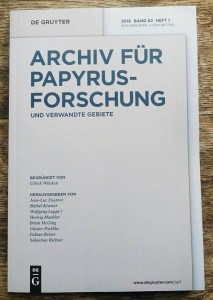
I’ve just received my copy of Archiv für Papyrusforschung 62/1 (2016):apf

I have in it an edition of a papyrus fragment of the Shepherd of Hermas housed in Paris (of the same leaf as the Hermas papyrus fragment in Prague) which I’ll upload soon here. I imagine the whole issue will be uploaded (for those with some sort of subscription, I believe) on the webpage of the journal, here. It is not live just yet.

I would also mention Christian Vassalo, “A Catalogue of the Evidence for Presocratics in the Herculaneum Papyri” the title is self-explanatory.  NT people may  well be interested in Peter Malik’s article on P.Beatty III (P47 in NT textual criticism, contains good parts of the Apocalypse of John, LDAB 2778) which pleads for an approach to early Christian codices that integrates the study of non- or paratextual and textual features, and discusses scribal corrections and the link between re-inking and textual variation.

Funded PhD at KU Leuven, Updated

There is an opportunity in Leuven for a PhD in Theology and Religious Studies. The way this works is the following: if you get this position, you have one year of funding  (starting in September, about 1800 euro/month net) in which one works and further refine one’s project with a supervisor (named ‘promoter’ here), and applies in January/February for a full PhD fellowship to the Belgian research agency – the FWO – for further four years (this one). UPDATE: There is an additional opportunity for after the first year, apart from the candidate’s FWO application: the promoter can also submit a project application with the FWO or the Research Council of KU Leuven. Two shots at it, as it were.

This means that if you get that, you end up with five years of full funding which should be enough to complete a thesis, take a few steps toward its publication, and apply for postdocs.

If you happen to be interested, I suggest you check the details, here (updated link), and get in touch with a professor in the faculty right away. The deadline is August 18 (updated).

There are here professors of Greek, respectively Latin Patristics, and the two professors of New Testament are interested in reception history as well.

Good luck!

Fresh on Augustine on the Hebrew Bible in the JTS

Edmon Gallagher posted on academia.edu the prepub version of a forthcoming JTS article: “Augustine on the Hebrew Bible“. Enjoy!

Abstract:

Augustine’s support for the Septuagint as the true Christian Old Testament never waned, but his understanding of the relationship between the Hebrew Bible and the Septuagint did develop over his career. His earliest statements assume that the Seventy translators faithfully rendered the Hebrew text, with any discrepancy resulting from ambiguity in the source text. His correspondence with Jerome convinced him that there was more to it than that. Augustine’s mature writings evidence an innovative theory whereby both the Hebrew text and its Greek translation could be correct, guiding the reader to spiritual insight, even if they said different things.

Fresh on Eriugena’s Biblical Interpretations

New book on Eriugena’s biblical exegesis:

Andrea Cavallini, La penna del pavone: Bibbia ed esegesi in Giovanni Scoto Eriugena (Fundamentis Novis 5; Rome: Cita nuova, 2016).

This seems to a revised version of Cavallini’s PhD thesis. The author has uploaded the introduction, conclusions and the TOC on his academia.edu page, here.

Blurb:

L’ermeneutica biblica di Giovanni Scoto, il contesto culturale, la dottrina e la pratica Giovanni Scoto, detto l’Eriugena (sec. IX), è senza dubbio uno dei pensatori più profondi e audaci dell’Alto Medioevo, capace di unire fides e ratio, tradizione latina e tradizione greca, Bibbia e arti liberali, in un’unica e armonica costruzione filosofico-teologica. In essa l’interpretazione della Scrittura gioca un ruolo centrale e costituisce il più difficile e importante campo d’azione della ragione umana. I significati del testo biblico sono infiniti, come innumerevoli sono le sfumature di colore che si ammirano in una sola penna di pavone, perché infinita è la ricchezza di Colui che nella Scrittura si rivela nascondendosi. Il volume introduce il lettore all’ermeneutica biblica di Giovanni Scoto, presentandone il contesto culturale, la dottrina e la pratica.

PhD Position on Apocryphal Literature at Strasbourg

For this interested in things apocryphal: in an email from AELAC (Association pour l’Étude de la Littérature Apocryphe Chrétienne), Prof Rémi Gounelle anounces that there is a PhD position available at Strasbourg, within the Ecole Doctorale de Théologie et de Sciences Religieuses. This is a 3-year fully funded PhD position to work with him (and others if necessary) on a thesis on apocryphal literature, which can be a critical edition and commentary, or a study of the history of the image of, and cults around characters in biblical and apocryphal literature. The language is French, and the place is great. For more info, feel free to contact Prof Rémi Gounelle, whose web page you can find here.


Latin Patristic Hermeneutics

New volume from CUP, announced for April:

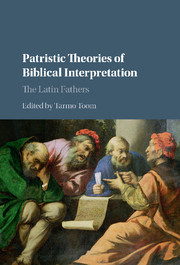
Tarmo Toom (ed.), Patristic Theories of Biblical Interpretation: The Latin Fathers (Cambridge: CUP, 2016).

latin

Blurb:

This volume provides an in-depth analysis of patristic hermeneutics for those who research, teach, or study the early church and the interpretation of Scripture. It focuses exclusively on Latin authors – such as Jerome, Augustine, and Gregory – whose writings contain substantial discussion of hermeneutics and who were known, read, and cited in the Middle Ages and beyond. In this collection of essays, leading international experts in the field identify key passages on patristic hermeneutical theory and demonstrate how the works of these authors have been fundamental for Latin traditions of biblical interpretation. Patristic Theories of Biblical Interpretation offers a selective yet comprehensive guide to a previously understudied area.

Contents:

1. Introduction | Tarmo Toom
2. Tyconius’ hermeneutics: the way the Holy Spirit expresses itself though the Scripture | Jean-Marc Vercruysse
3. Jerome’s hermeneutics: how to exegete the Bible? | Aline Canellis
4. Augustine’s hermeneutics: the science of the divinely given signs | Tarmo Toom
5. Cassian’s hermeneutics: purity of heart and the vision of God | Christopher J. Kelly
6. Junillus Africanus’ hermeneutics: Antioch and beyond | Peter W. Martens and Alden Bass
7. Cassiodorus’ hermeneutics: the Psalms and the arts of language | Rita Copeland
8. Gregory’s hermeneutics: scripture as a path to God | Brendan Lupton
9. Isidore’s hermeneutics: the codification of the tradition | Thomas O’Loughlin.

Two CfPs in Patristics

The first just arrived in an AIEP/IEPS email. It is in St Petersburg, 9-11 September 2016.

The Asia-Pacific Early Christian Studies Society invites proposals for papers to be delivered at its tenth annual conference to be held at State University of Aerospace Instrumentation (SUAI), St Petersburg, Russia, from Friday morning, 9 September to Sunday afternoon, 11 September, 2016, convened by Basil Lourié. Papers are 30 minutes in duration (20 minutes delivery and 10 minutes for discussion). The Society welcomes all proposals that explore any theme relevant to the early Christian world from the New Testament to the end of Late Antiquity, and especially those that focus on this year’s theme: Survival of Early Christian Traditions. A 100-word abstract should be sent by 30 April, 2016 to Dr. Geoffrey D. Dunn (geoffrey.dunn@acu.edu.au). Registration forms and further details will be available soon on the Society’s website at http://www.cecs.acu.edu.au/apecss.htm [this link does not work yet]. For more information, see the attached file, here.

The other one is further away still, but should include some papers on patristic exegesis.

The Seventh Saint Andrew’s Patristic Symposium, 23-24 September 2016, focuses on the personality, contributions and legacy of Saint John Chrysostom. Keynote speakers: Prof. Pauline Allen and Dr. Wendy Mayer. Plenty more information is available here.

There you have it.

Fresh French Translation of Eckhart’s Commentary on the Wisdom of Solomon

New book from Les Belles Lettres:

22510100810670L

Maître Eckhart, Commentaire du Livre de la SagesseTranslation from Latin by Jean-Claude Lagarrigue and Jean Devriendt, with introduction and commentaries byMarie-Anne Vannier (Sagesses médiévales; Les Belles Lettres 15: Paris, 2015).

Blurb:

Ce livre constitue la première traduction française du Commentaire de la Sagesse. C’est un événement pour les études eckhartiennes, dans la mesure où il rend accessible une oeuvre majeure d’Eckhart, en la situant dans son contexte : celui de l’enseignement parisien du Thuringien, et en en dégageant ses enjeux.
Illustrant l’unité organique de l’oeuvre tripartite, qui est partiellement perdue, leCommentaire de la Sagesse nous donne une idée de cette grande synthèse théologique où, à partir de l’Écriture, qu’il lit en tenant compte de l’apport de Maïmonide et des Pères, Eckhart apporte une contribution originale à l’anthropologie. Articulée autour de la figure du juste, son anthropologie est fondée sur une ontologie théologale, où il envisage le passage de la création à la création nouvelle et explique que la Trinité rend possible la naissance de Dieu dans l’âme.
Cet ouvrage présente également l’intérêt d’être l’un des seuls commentaires complets du Livre de la Sagesse, même s’il en retient principalement quatre-vingt-onze passages. Et pour en rendre compte, Eckhart s’appuie sur l’acquis de ses prédécesseurs : principalement Augustin et Maïmonide, et il apparaît même comme l’un des meilleurs lecteurs d’Augustin au Moyen Âge. Dans ce Commentaire, Eckhart passe de la sagesse philosophique à la sagesse théologique pour en venir à la sagesse mystique.

Create a free website or blog at WordPress.com.

Up ↑