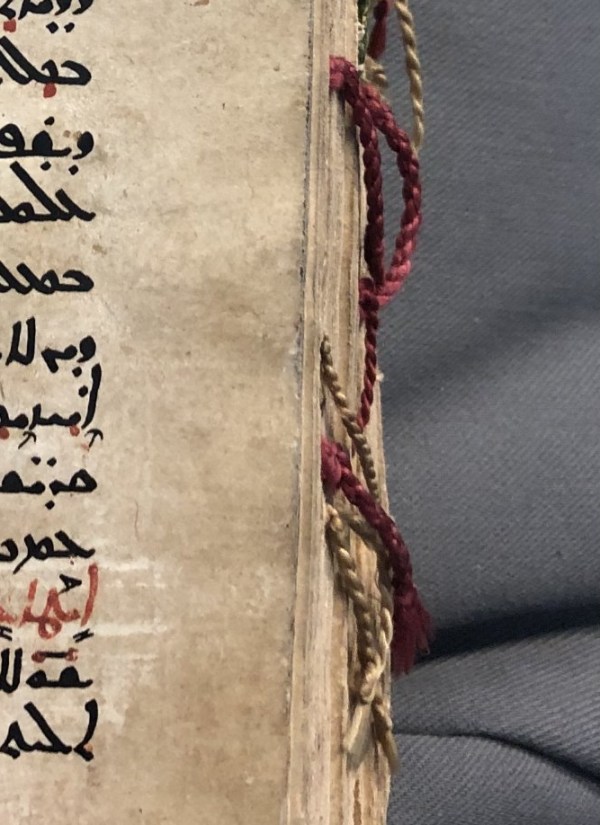
I’ve also started a twitter/x thread on bookmarks and tabs in manuscripts in all shapes and forms, bookmarks I chanced upon working on manuscripts, and many found around twitter/x. There are many examples, as this seems to be a wide practice and since some are vanishing off twitter, I grouped them here too.
It’s a very nice series of seminars, and I’m quite thrilled to give a paper in this context. Do check the other papers here.
Finding a Home: The West Syriac Context of the Clementine Epistles on Chastity
The two epistles De virginitate attributed to Clement of Rome seem to have been composed in Greek but only survived as a whole in Syriac. The publication of the Syriac text, known until recently from only one witness of the fifteenth century, led then to the double identification of a handful of excepts in Greek, quoted without attribution in one late-antique exegetical work, and of the fragment of one Coptic witness. The Syriac, however, remains the most interesting. Since the last edition (Beelen, 1856), a series of new witnesses have emerged that further document what was initially thought to be a fluke due to a scribal confusion: the fact that the two epistles are included as an integral part in several Syriac New Testament collections. This lecture aims to reconstruct the West Syrian context that led to this inclusion, which alone should probably be credited with the survival of the two epistles.
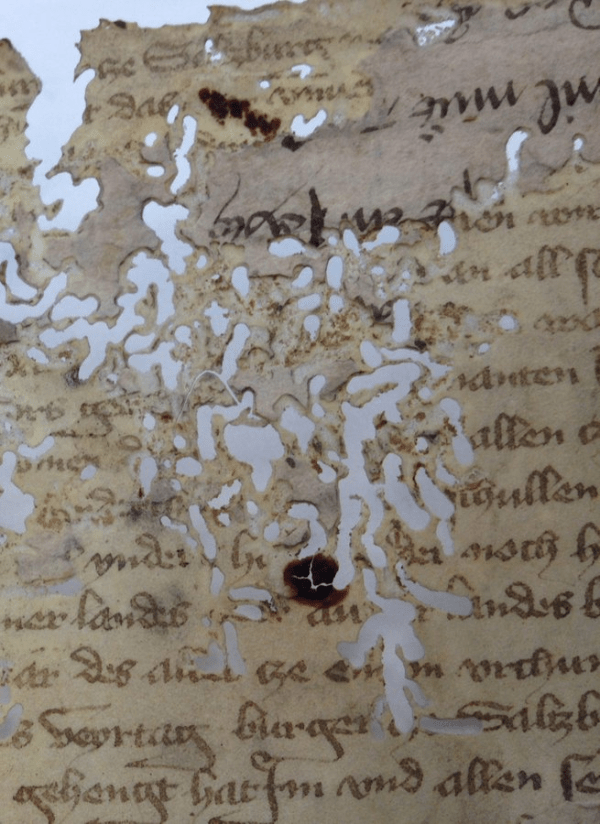
A couple of years back I started on twitter/x a thread collecting the twitter/x posts with damaged books and damaged manuscripts. It’s been a ride, but images are still popping up. Here are a few, with links to their initial tweets. Just goes to show what can happen.
There are two TeTra events this week, a research seminar paper from Oana Maria Cojocaru (Tampere) and the first TeTra Lecture of 2025 by Jost Gippert (Hamburg), in successive days. Here are the details (do note the different times!):
Wednesday 24 January, 4 pm CET| TeTra Lecture
Jost Gippert (Universität Hamburg) The Written Heritage of Caucasian Albanian
According to his pupil Koryun, the Armenian monk Mesrop Mashtots (early 5th century) created not only the Armenian alphabet but also one for the neighbouring people of the so-called Caucasian “Albanians”. It took until 1937 for the first evidence of this alphabet to be found, in an Armenian manuscript that contains a list of 52 “Albanian” letters and their names. A few years later, excavations in northwestern Azerbaijan revealed some inscriptions that appeared to be written in the same alphabet. With the discovery of two Georgian palimpsest manuscripts among the so-called “New Finds” in St Catherine’s Monastery on Sinai, whose deleted script could also be determined to be “Albanian”, it was finally possible to decipher the language of the Caucasian “Albanians” and to make the surviving text materials, all of them biblical, accessible to scientific research in an edition that was published in 2008.
In my paper, I will briefly trace the history of the decipherment of Caucasian-Albanian before discussing new insights that have been made since the publication of the edition through the use of new imaging technologies for the decipherment of palimpsests. We will deal with the analysis of the Albanian alphabet, the expansion of the Albanian lexicon with new word material – inherited and borrowed – as well as new insights into the grammar of Albanian. Particular attention will be paid to the question of the relationship between the Albanian Bible texts and those of neighbouring languages.
Jost Gippert is Senior Professor at the Universität Hamburg and Principal Investigator of the ERC Advanced Grant project ‘The Development of Literacy in the Caucasian Territories’ (DeLiCaTe) (2022-2027), having previously held positions in Berlin, Vienna, Salzburg, Bamberg, Tbilisi, and Frankfurt am Main.
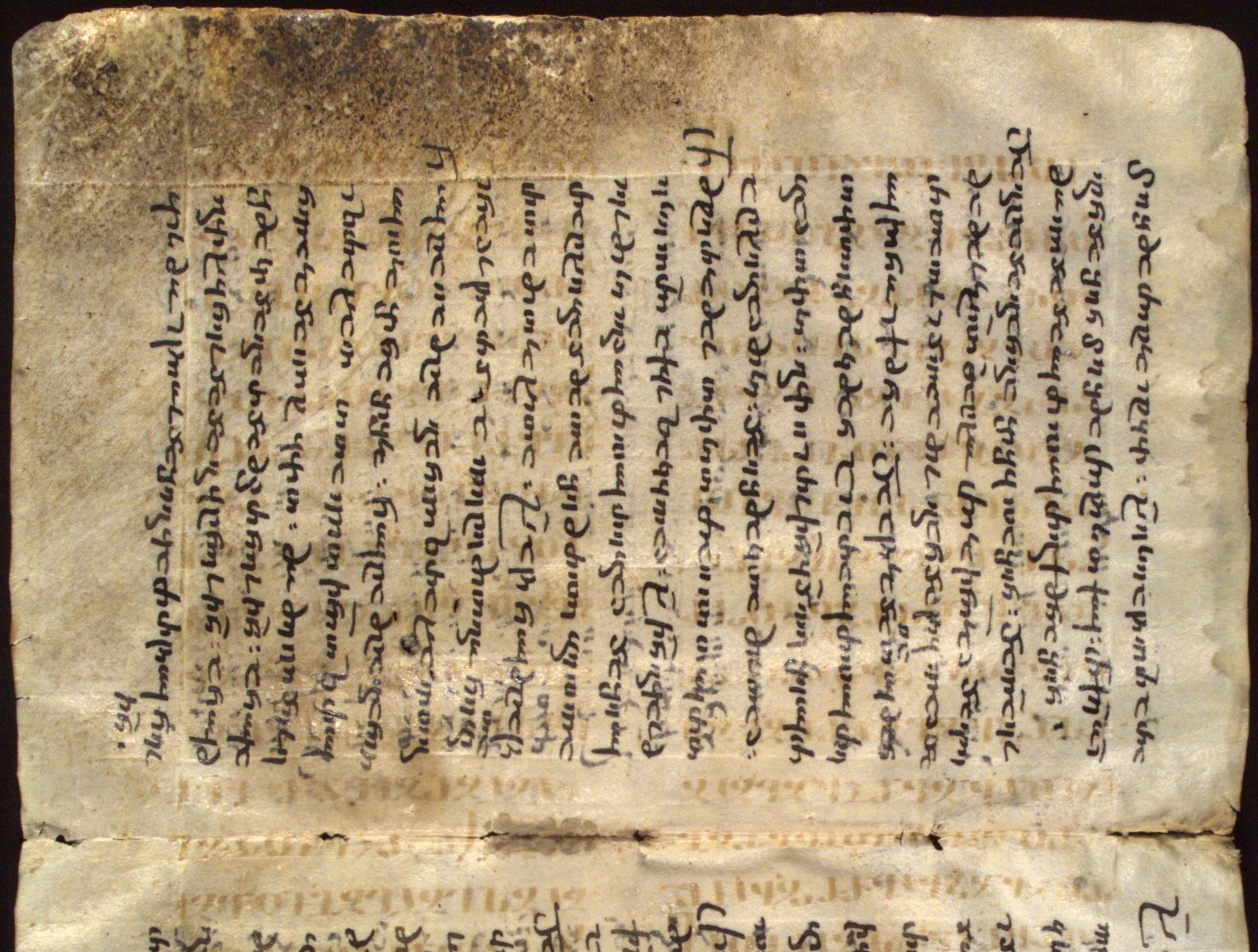
In the image the palimpsest manuscript Sin. georg. NF 13.
Thursday 25 January 2024, 10 am CET
Oana Maria Cojocaru (Tampere University) Dis/ability and Byzantine Hagiography
Religion held a central role in the daily lives of the Byzantines, not only shaping their identity but also guiding their actions and interactions and shaping their worldview. A fundamental aspect of Byzantine Christianity was the veneration of saints, which offer individuals a platform where they could make sense of their experiences of life, ask for help, express their hopes, fears, and anxieties, and voice their emotions in a cultural sanctioned way. The cult of the saints which prompted a prolific literary tradition detailing their lives, deeds and miracles, serves as a lens to explore the various ideas and conceptualizations of disability in the Byzantine world, and to a limited degree the lived experiences of the disabled. In this presentation I will discuss first the differences in the narrative teatments of disability by various hagiographers, and their attempts at explaining its source or reason depending on their religious and moral agendas. In the second part, I will discuss the religious practices that have at the center the disabled people from all walks of life, with a particular focus on the actions and interactions in various forms of these people with the saints and their relics.
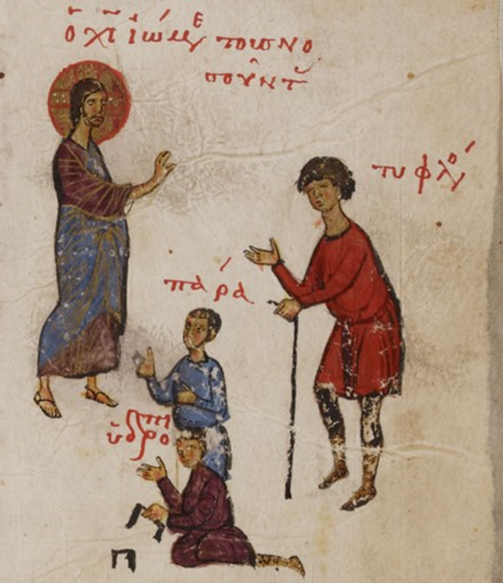
Image: Christ healing the sick, manuscript illumination from The Theodore Psalter (1066), British Library Additional MS 19352, 136r.
If you are interested in attending and are not yet on the TeTra mailing list, please get in touch with one of the TeTra convenors to receive the Zoom link, at marion.pragt@kuleuven.be, giorgia.nicosia@ugent.be, andy.hilkens@ames.ox.ac.uk, or dan.batovici@kuleuven.be.
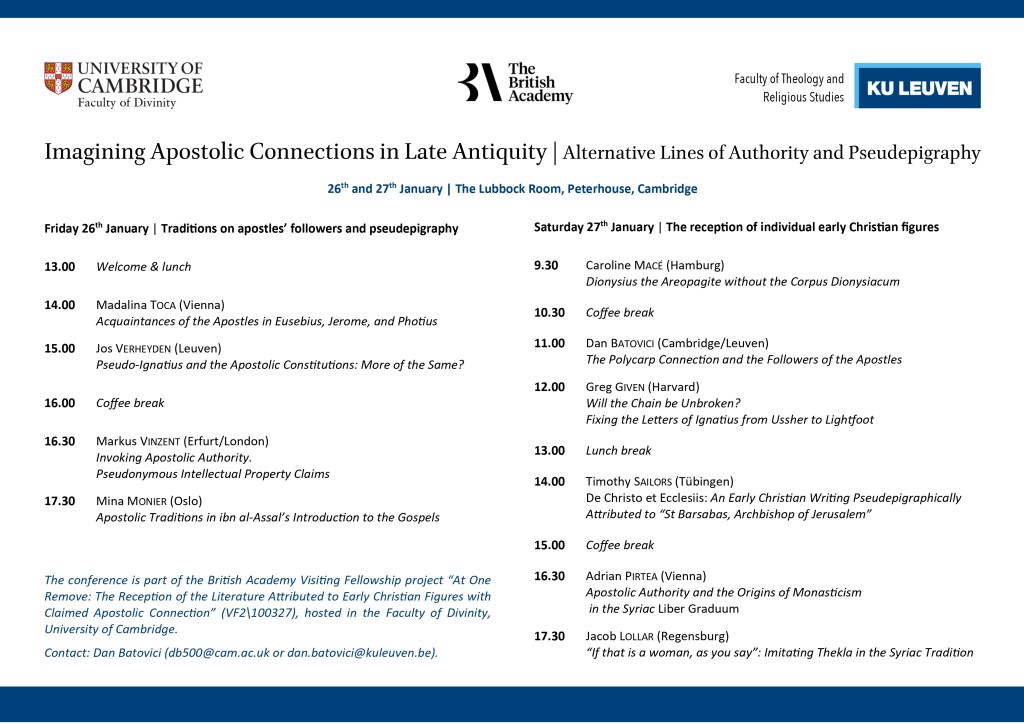
Later this month, if you happen to be in Cambridge, you’re welcome to attend this two-day conference on the literature around characters with claimed apostolic connections.
The conference is part of the British Academy Visiting Fellowship project “At One Remove: The Reception of the Literature Attributed to Early Christian Figures with Claimed Apostolic Connection” (VF2\100327), hosted in the Faculty of Divinity, University of Cambridge. Contact: Dan Batovici (db500@cam.ac.uk or dan.batovici@kuleuven.be).
Imagining Apostolic Connections in Late Antiquity | Alternative Lines of Authority and Pseudepigraphy 26th and 27th January | The Lubbock Room, Peterhouse, Cambridge
Friday 26th January | Traditions on apostles’ followers and pseudepigraphy
13.00Welcome & lunch
14.00 Madalina Toca (Vienna) Acquaintances of the Apostles in Eusebius, Jerome, and Photius
15.00 Jos Verheyden (Leuven) Pseudo-Ignatius and the Apostolic Constitutions: More of the Same?
17.30 Mina Monier (Oslo) Apostolic Traditions in ibn al-Assal’s Introduction to the Gospels
Saturday 27th January | The reception of individual early Christian figures
9.30 Caroline Macé (Hamburg) Dionysius the Areopagite without the Corpus Dionysiacum
10.30Coffee break
11.00 Dan Batovici (Cambridge/Leuven) The Polycarp Connection and the Followers of the Apostles
12.00 Greg Given (Harvard) Will the Chain be Unbroken? Fixing the Letters of Ignatius from Ussher to Lightfoot
13.00Lunch break
14.00 Timothy Sailors (Tübingen) De Christo et Ecclesiis: An Early Christian Writing Pseudepigraphically Attributed to “St Barsabas, Archbishop of Jerusalem”
15.00Coffee break
16.30 Adrian Pirtea (Vienna) Apostolic Authority and the Origins of Monasticism in the Syriac Liber Graduum
17.30 Jacob Lollar (Regensburg) “If that is a woman, as you say”: Imitating Thekla in the Syriac Tradition
Built up as a library guide at Helsinki University by Matti Myllykoski, it contains far more info than usual in the available critical editions.
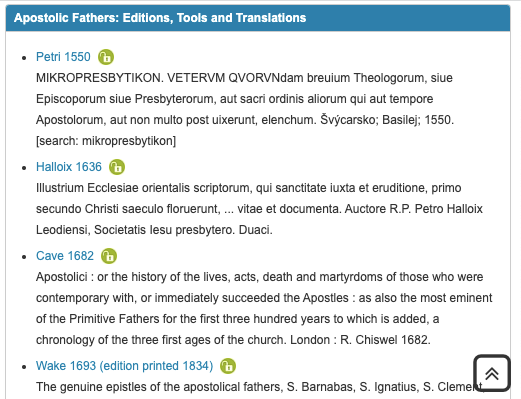
It features an impressive list of printed collection that include in some way AF, all with hyperlinks to http://archive.org, with several items pre-dating the (slightly) better known Cotelier. Truly an excellent resource for anyone interested in the history of the corpus.
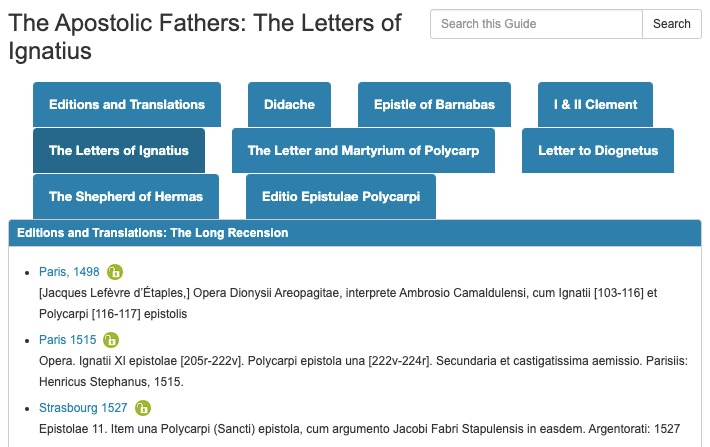
Then, for individual AF, you’ll find again links to all printed editions and translations (old and new) that can be found online in repositories like archive org or google books. These are only rarely even listed even in critical editions; have a feel, those links are mint!
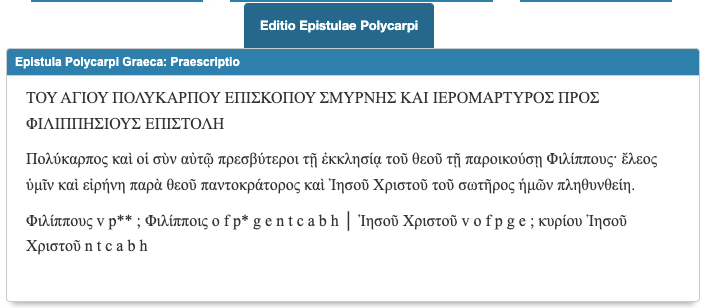
The manuscripts found online (from microfilm, from scanned publications, recent photographs, editions) are then also listed.
For the Shepherd of Hermas there are links to the main Greek witnesses, 21 (out of some 28!) Latin witnesses, 20 papyri, the edition of some Coptic fragments and an edition the Middle Persian in the public domain.
Also great is the fact that for Ignatius of Antioch it also lists the online editions, translations, and witnesses of the “long recension” or with “extra” letters which are usually discarded, but which form the context in which the seven “authentic” letters are virtually always transmitted in mss.
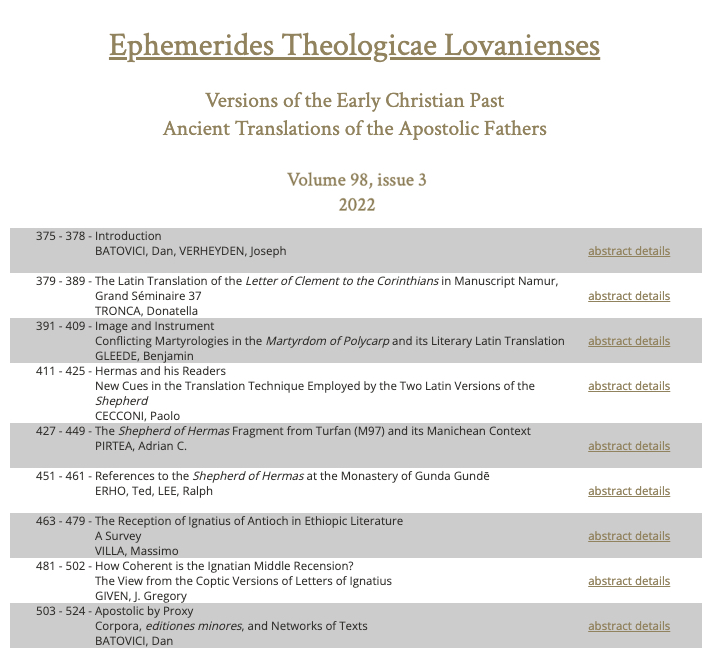
For convenience, here’s the table of contents, followed by the abstracts of each paper. Note that Greg Given’s article is readily available in Open Access, but feel free to get in touch if you need another article and don’t have access. The introduction is available here.
The article provides an analytical description of manuscript Namur, Grand Séminaire 37, which contains the only witness of the Latin translation of Clement’s First letter to the Corinthians. While scholars have dated the production of this codex generally to the eleventh century, a palaeographical and codicological analysis enables us to give a more precise dating in the years straddling the eleventh and the twelfth century. The production of the manuscript within this period, defined by Paul Fournier as un tournant de l’histoire du droit, makes it a building block in the political and ecclesiastical construction of papal primacy in the Middle Ages.
The Martyrdom of Polycarp was translated into Latin three times during antiquity, twice in a literary, once in a literal manner. Alongside the famous and most successful literary translation contained in Rufinus’ version of Eusebius’ Church history we have an anonymous literary version which at closer inspection shows an even higher degree of theological reflection than its more famous predecessor. Where the Greek original tries to underscore the Christ-conformity of its hero as much as possible, perhaps even to a degree that might compromise Christ’s unicity as the archetype, the Latin translator uses every chance to avoid such a misunderstanding and underscore the martyr’s inferiority to and dependence upon Christ and grace. Thus, probably the most plausible historical background for this translation would be Augustine’s controversy over the issue of martyrdom during the 420s.
The Shepherd of Hermas is one of the best documented literary works of the second century AD. It belongs to the first layer of Greek Christian texts and was soon translated into Latin (twice). These translations shed new light on the intercultural and intertextual exchanges between different linguistic groups, who shared the same background and have the same values, but adapted the translations to their own cultural context. This article investigates in depth both Latin translations, drawing on the author’s work on the new critical editions of Vulgata and Palatina, and on methodological investigations into how to translate a text from Greek into Latin, also taking into account new studies on the textual transmission of the Shepherd itself and on the Ge’ez translation.
This article discusses the Manichaean Middle Persian translation of the Shepherd of Hermas (Berlin, Turfan Collection, M97) and investigates the possible reasons as to why Manichaeans developed an interest in this early Christian work. After a short overview of previous scholarship, I provide a codicological, palaeographic and philological analysis of M97 and its relationship to the Greek, Latin, Coptic and Ethiopic versions of the Shepherd. The relevance of another Manichaean fragment from Turfan that mentions ‘Hermas the Shepherd’ (M788) is also briefly addressed. The main part of the article attempts to explain how the text of the Shepherd was transmitted to the Manichaeans in Central Asia and what function this work had in Manichaean church life. I argue that the Manichaean Middle Persian version of the Shepherd played an important, yet hitherto unacknowledged role as a collection of didactic parables, and that its usefulness for homiletics and preaching is analogous to the Manichaean Sogdian Book of Parables (Āzandnāme) derived from Buddhist sources.
The monastery of Gunda Gundē played a significant historical role in preserving the Ethiopic translation of the Shepherd of Hermas, but its relationship to the book was not simply as a passive guardian. As witnessed through a few locally-produced commentary manuscripts referencing this work, at least some monks actively engaged theologically with it. Their interest in the Shepherd may have been stimulated in part by writings alluding to Hermas authored by the fourteenth-century Ethiopian theologian Retu‘a Hāymānot, copies of which were also held by the monastery.
In this contribution I study the presence and circulation of the writings of Ignatius of Antioch in Ethiopic literature. In Ethiopia Ignatius was undoubtedly less popular than other subapostolic authors and his epistles were never translated in their entirety into Ethiopic. However, fragments of his corpus reached the Horn of Africa via Copto-Arabic sources in the form of quotations. As is often the case with patristic literature, the Ignatian legacy was characterized by adaptations and pseudepigraphy. Genuine and spurious quotations are found in Severos of Ašmunayn’s works, translated into Ethiopic no later than the fourteenth century, and two additional pseudo-Ignatian quotations are transmitted in the Hāymānota ʾabaw, or ‘Faith of the Fathers’ (sixteenth century). These fragments were later incorporated into several commentaries and treatises of theological and catechetical contents.
Over the past century and a half, most scholars have presumed that the earliest Greek text of the letters of Ignatius is a seven-letter collection known as the ‘Middle Recension’. This article aims to trouble the three-recension model of the textual transmission of the Ignatian letters, which undergirds this consensus. First, the article presents an overview of the manuscript witnesses to the ‘Middle Recension’, illustrating the diverse texts collected together under the umbrella of this purportedly singular ‘recension’. Then the article takes a close look at the two extant Coptic versions of the letters of Ignatius, which present unique selections and arrangements of the collection unaccounted for by the three-recension model. These versions also contain distinctive textual variants that evince interpretive engagement and further illustrate the model’s heuristic limitations. Instead of interpreting the Coptic versions as mere witnesses to the Greek text, the article argues that the Coptic texts represent valuable evidence for the processes by which the memory of the earliest period of Christianity was re-crafted to constitute a usable past in late antique and medieval Egypt.
This article discusses the pre-modern basis for the otherwise modern AF corpus. To that end, it offers an overview of the manuscript witnesses in Greek, Latin, and Syriac, and shows that the AF were already connected in various ways (albeit as a network of texts rather than a closed list), and moreover that the information preserved in paratext often connects the AF with the apostles. Furthermore, it argues that the view from early Christian studies, focusing for the last hundred years mostly on the Greek and adopting what was initially an editio minor as the AF ‘canon’, obscures the understanding of how these texts were perused and associated with other texts in various late antique and medieval Christian contexts.
Brief note to say that I received my contributor copy of this volume the other day.
My chapter deals with “Reading Aids in Early Christian Papyri“. I uploaded my contribution here, but the whole volume is open access; check it out here. There are several articles on similar matters in manuscripts that belong to different religious traditions e.g. the Dead Sea Scrolls, Qur’ān, Medieval Jewish and Christian contexts. The second part of the book present ongoing projects or methodological discussions of digital manuscript projects.
All contributions are of course excellent. Matthieu Cassin’s contribution in particular is a fifty-page, very informed and very useful survey on approaches to critical editions in patristics.
Here goes the abstract:
An overview of recent editions of Greek texts from Christian Antiquity is provided, with particular attention to the question of theories and methods of edition. First, we recall the main methods involved: the Lachmannian method, corrected or not by historical approaches, New Philology, etc. In a second step, we go through some large collections of editions of patristic texts, in order to identify their specificities and study their main recent productions; these are successively examined: Athanasius Werke; Gregorii Nysseni Opera; Die griechischen christlichen Schriftsteller der ersten Jahrhunderte; Patristische Texte und Studien; Corpus christianorum, series graeca; Sources chrétiennes. Some special cases are then considered: single-witness texts; treatment of overabundant traditions and phylogenetic methods; partial editions; anthologies, exegetical catenae and compilations. Finally, we propose a general reflection on the changes introduced in the editing process by the introduction of digital technologies, up to and including electronic edition itself.










 reception matters & manuscripts