New book from the Presses Universitaires de Liège:
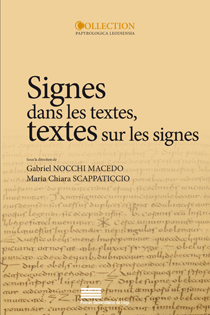
Gabriel Nocchi Macedo and Maria Chiara Scappaticcio (eds.). Signes dans les textes, textes sur les signes: Érudition, lecture et écriture dans le monde gréco-romain.
Papyrologica Leodiensia 6; Liège: PUL, 2017.
The various paratextual signs found here and there in early-Christian papyri and manuscripts have drawn quite some attention during the last decade for the possible clues they could offer not only about the use of these manuscripts but possibly also about liturgical practices and the formation of the canon.
This book offers sixteen contributions on the Greek and Roman background on signs found in manuscripts and inscriptions, and should therefore inform all future developments of such debates. The papers are written in Italian, English, Spanish and French, so it should be good fun. I’ve pasted the contents below, for convenience. Daniela Colomo’s article, on quantity marks in Greek prose texts on papyrus, is available online here.
Guglielmo CAVALLO
Prefazione
Maria Chiara SCAPPATICCIO
Segni nei testi, testi sui segni: perché?
Julia LOUGOVAYA‐AST
Some Observations on the Usage of Punctuation in Early Greek Inscriptions
Lucio DEL CORSO
Segni e layout delle iscrizioni greche in Egitto. Un sondaggio su testi esposti in prosa
Alberto NODAR DOMÍNGUEZ
Los signos de lectura más antiguos en papiro
Gianluca DEL MASTRO
La ponctuation dans les papyrus grecs d’Herculanum
Daniela COLOMO
Quantity Marks in Greek Prose Texts on Papyrus
Kathleen MCNAMEE
Sigla in Late Greek Literary Papyri
Rodney AST
Signs of Learning in Greek Documents: the Case of spiritus asper
Eleanor DICKEY
Word Division in Bilingual Texts
Rodolfo FUNARI
Segni di interpunzione e di lettura nei frammenti storici latini da papiro e pergamena rivenuti nell’Egitto
Gabriel NOCCHI MACEDO
Textes sur les signes : les sources latines
Giuseppina MAGNALDI
Integrazioni con parola‐segnale in manoscritti ciceroniani e apuleiani
Serena AMMIRATI
Segni nei libri: esempi e problemi nei manoscritti medievali di contenuto grammaticale
Louis HOLTZ
La pratique de la ponctuation dans les manuscrits de Lyon du Ve au IXe siècle
Claudio GIAMMONA
Ricezione ed evoluzione di un trattato elementare : le Declinationes e le redazioni dell’Ars Ambianensis
Fidel SEBASTIÁN MEDIAVILLA
Herencia clásica en la ponctuación y la acentuación del Siglo de Oro español

 reception matters & manuscripts